
Testwell CMT++/CMTJava
Code Complexity Measurement Tools for C, C++, Java, and C#
Why Code Complexity Analysis ?
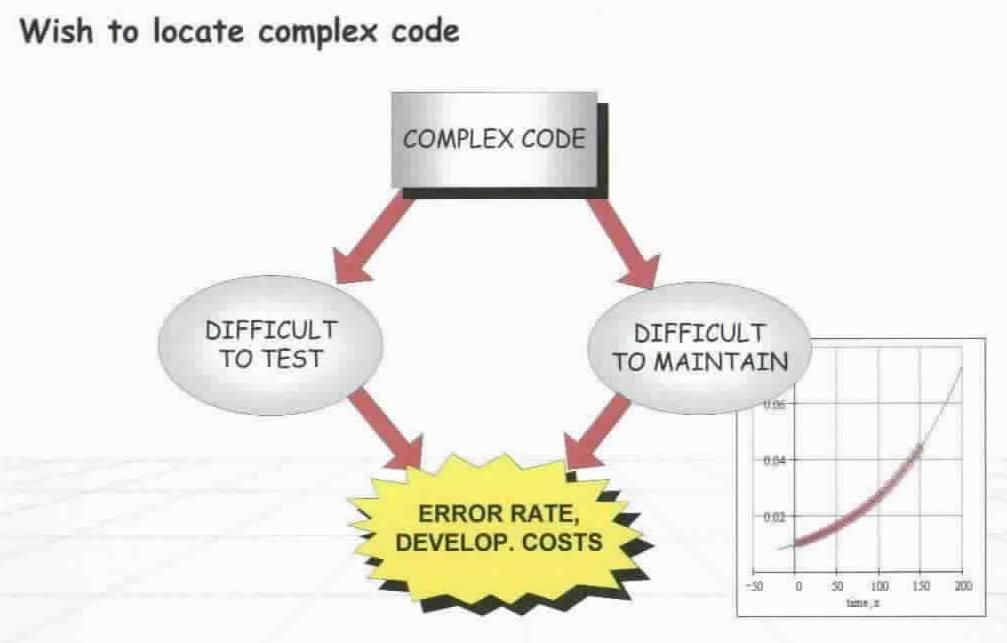
Code complexity correlates with the defect rate and robustness of the application.Complex code is difficult to test. There are most likely more errors in complex code than in less complex code.
Complex code is difficult to maintain. This increases costs.
The Code complexity measurement tool Testwell CMT++ (for C, C++ and C#) and Testwell CMTJava (for Java) saves costs and avoids software erosion. For this reasons several standards (like ISO 26262) require the enforcement of low code complexity.
What is measured by Testwell CMT++/CMTJava ?
Based on the static properties of the program code CMT++ and CMTJava gives estimates how error prone the program source code is due to its complexity, how long it will take to understand the code, what is the logical volume of the code, etc ...As the project team has not usually time to inspect all the code produced by the project, CMT++/CMTJava can assist in locating the modules, which are most likely to cause problems in the future.
Testwell CMT++ und Testwell CMTJava help by measuring the code quality. This is particularly interesting for companies which subcontract their software development. Subcontractors can proof the quality of their code with Testwell CMT++/CMTJava.
Testwell CMT++ and CMTJava analyse your applications for the following metrics:
- Lines-of-code Metrics (LOC)
- Halstead-Metrics
- McCabe Cyclomatic Number v(G)
- Maintainability Index
- Max ND / Maximum Nesting Depth
Alarm limits can be customized
The alarm limits given by default are common suggestions, based on measurements on code maintained with good success. Testwell complexity measurement tools uses metrics established in research projects during several years in the USA (Software Engineering Institute of Carnegie Mellon University).The metrics used by CMT++ and CMTJava are industrial standards.
As it is not possible to give absolute limits to acceptable values, Testwell complexity measures tools allows you to customise the alarm limit definitions of the software metrics in the configuration file for your projects specific needs.
Testwell CMT++/CMTJava Highlights
- Analyses original non-pre-processed files
- Extremely fast -> analyses your applications in a couple of minutes
- Handles many and big files
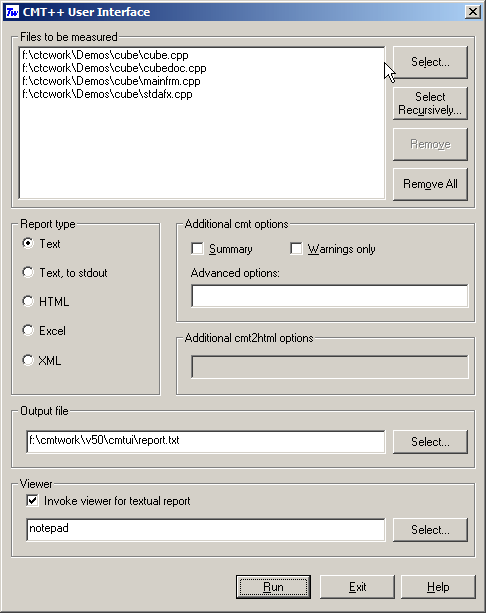
- HTML or textual reporting -> measurements can be further processed by Excel
- GUI integration in Visual C++ Developer Studio
- Available on many platforms: Windows, Linux, HP, Solaris
Verybench: Front End with Several Graphical Views
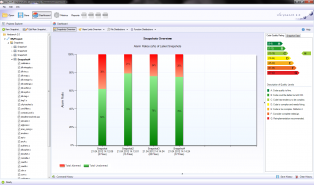
Verybench is a graphical user interface for the code complexity measuring tool Testwell CMT++.It enables managers, developers as well as quality and test engineers to collaborate easier on and to contribute easier to source code quality. It accelerates the way metrics are understood by an entire development team and not just by single individuals involved in improving the quality of a software.
Verybench comes with two kinds of main views: the Dashboard Views and the Metrics Views.
Further information: Verybench
Flyers, White-Papers and Presentations
Testwell CMT++/CMTJava Product Flyer
in different languages: 







![[PDF]](icon-pdf-15x16.gif) Testwell CTC++ Produktbroschüre (Deutsch)Testwell CTC++ Produktbroschüre (Englisch)Testwell CTC++ Produktbroschüre (Französisch)Testwell CTC++ Produktbroschüre (Italienisch)Testwell CTC++ Produktbroschüre (Spanisch)Testwell CTC++ Produktbroschüre (Niederländisch)Testwell CTC++ Produktbroschüre (Russisch)Testwell CTC++ Produktbroschüre (Japanisch)Testwell CTC++ Produktbroschüre (Koreanisch)
Short Slide-Presentation (24 Slides, 900 KB) Extended Slide-Presentation (50 Slides, 1,2 MB)
Testwell CTC++ Produktbroschüre (Deutsch)Testwell CTC++ Produktbroschüre (Englisch)Testwell CTC++ Produktbroschüre (Französisch)Testwell CTC++ Produktbroschüre (Italienisch)Testwell CTC++ Produktbroschüre (Spanisch)Testwell CTC++ Produktbroschüre (Niederländisch)Testwell CTC++ Produktbroschüre (Russisch)Testwell CTC++ Produktbroschüre (Japanisch)Testwell CTC++ Produktbroschüre (Koreanisch)
Short Slide-Presentation (24 Slides, 900 KB) Extended Slide-Presentation (50 Slides, 1,2 MB)Technical Product Information Testwell CMT++ (English)
Technical Product Information Testwell CMTJava (English)
User Guides
Testwell CMT++ Version 7.0
Testwell CMTJava Version 4.0
Latest News
(current CMT++-version: 7.0)
(current CMTJava-version: 4.0)
- Release of Testwell CMT++ Version 7.0 and CMTJava 4.0
- Testwell CMT++ Version 6.0.1 available
- New Version of Testwell CMT++ 6.0 with C#-Support Available
- Verybench 2.1: New Graphical Interface for Testwell CMT++ Available
- New Company and Testwell Tool Flyer Available
- Verifysoft acquires intellectual property rights for Testwell CTC++, CMT++/CMTJava and CTA++ from Testwell Oy Finland
- Code Complexity Measurement for Java: Testwell CMTJava 3.0 Available